
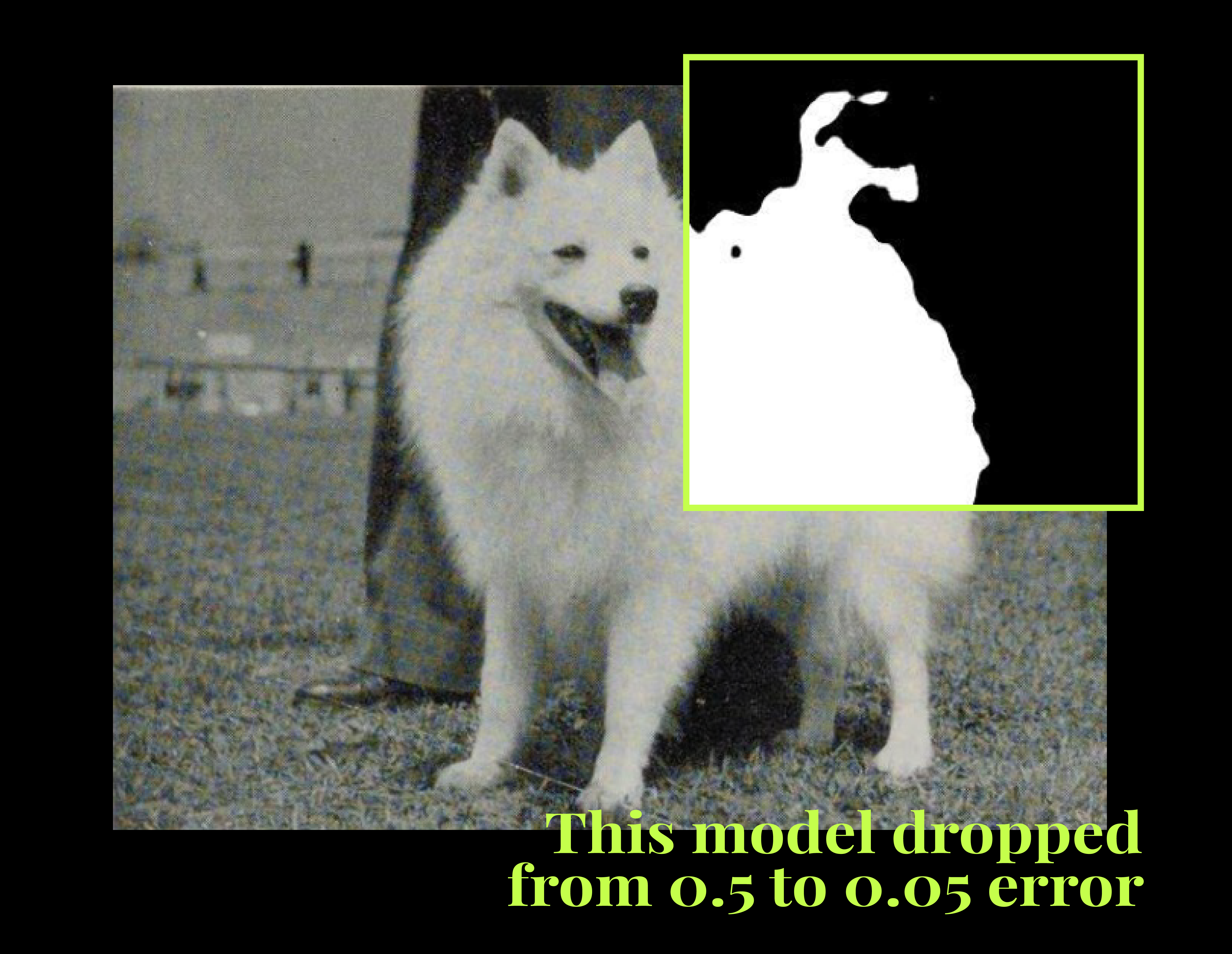
At Furnets, we explore dog silhouette modeling with a data-driven approach. With 50 photo-silhouette pairs, our exploration unfolds methodically, navigating through iterations and insights. Our methodology prioritizes understanding and simplicity, evolving from rudimentary to sophisticated constructs.
In our dataset, curated pragmatically, we experiment to discern our model’s efficacy with minimal resources. Models under 100k parameters prove powerful, transcending their modest size. The quest for speed and efficiency uncovers nuances; a model with 200k parameters may outperform a leaner 50k counterpart.
Our focus is on learning velocity, measured by Mean Absolute Error during training. Starting at 0.5, the error quickly drops below 0.1, revealing discernible silhouettes at 0.05. These experiments on 512×512 images include five transformations—black and white, contrast, brightness, horizontal flip, and compression—adding diverse perspectives to the dataset.
Results Overview:
- Training Data Performance: Initial assessments of the training dataset revealed promising results, sparking our excitement for further investigation.
- Handling Out-of-Sample Data: Nevertheless, when presented with images beyond the dataset, we encountered difficulties. Our endeavors to cover a wide range of dog images, encompassing even older, lower-quality pictures, produced mixed results, highlighting areas for enhancement.
- Dataset Expansion Efforts: To enhance our dataset, we incorporated black and white data. Unfortunately, simple augmentation was not enough, necessitating a thorough review of our approach. Despite our diligent work, integrating these variations resulted in challenges, such as compilation errors in more complex model iterations.
Refining Model Training Visualization
Graphical representations were created to clarify the model training process, with the goal of improving understanding. Yet, a consistent finding arose: the silhouette consistently stayed within a limited range of values, suggesting the need for a deeper investigation into the model’s layers.
Training data outcome:


Result with a photo not included in the dataset:


We also attempted a version in which the dog is fully visible (an old photo of low quality).


We then included black and white data in the dataset. However, merely introducing black and white instances to the dataset proved insufficient. This has been the outcome thus far. It seems we cannot proceed without complicating the model. I believe everything remains achievable within the hourglass framework. Nevertheless, we have been facing compilation errors with the intricate version.


We have created graphs to visualize the model training process for better clarity. Yet, rather than gaining insight, the silhouette consistently hovers around the same values. Let’s persist in our search for the juncture where we must explore the layers further.


Advanced model

We’ve enhanced one silhouette in the revised model.


The results for the second silhouette, however, deteriorated.

Advanced model training visualization.

Advancements in Model Development
Although progress was achieved in enhancing one silhouette in the revised model, difficulties continued with the other silhouette, leading to declining outcomes. Despite challenges, our dedication to innovation remains strong as we work to address obstacles and improve our approaches.
Thank You for Your Interest
We appreciate your interest in our efforts to advance dog silhouette modeling. Keep an eye out for updates and subscribe to get our newest insights and progress. At Furnets, we are committed to consistently improving our model, fueled by a drive for innovation and quality.
We’ve found two key research papers invaluable for our work:
- “Deep Residual Learning for Image Recognition” by Kaiming He et al., presented at CVPR 2016. It’s helped us understand deep learning for image recognition. Read it here.
- “Batch Normalization: Accelerating Deep Network Training by Reducing Internal Covariate Shift” by Sergey Ioffe and Christian Szegedy. This paper, available here, has shaped how we train deep neural networks.
Author — Egor Zyryanov
Leave a Reply