
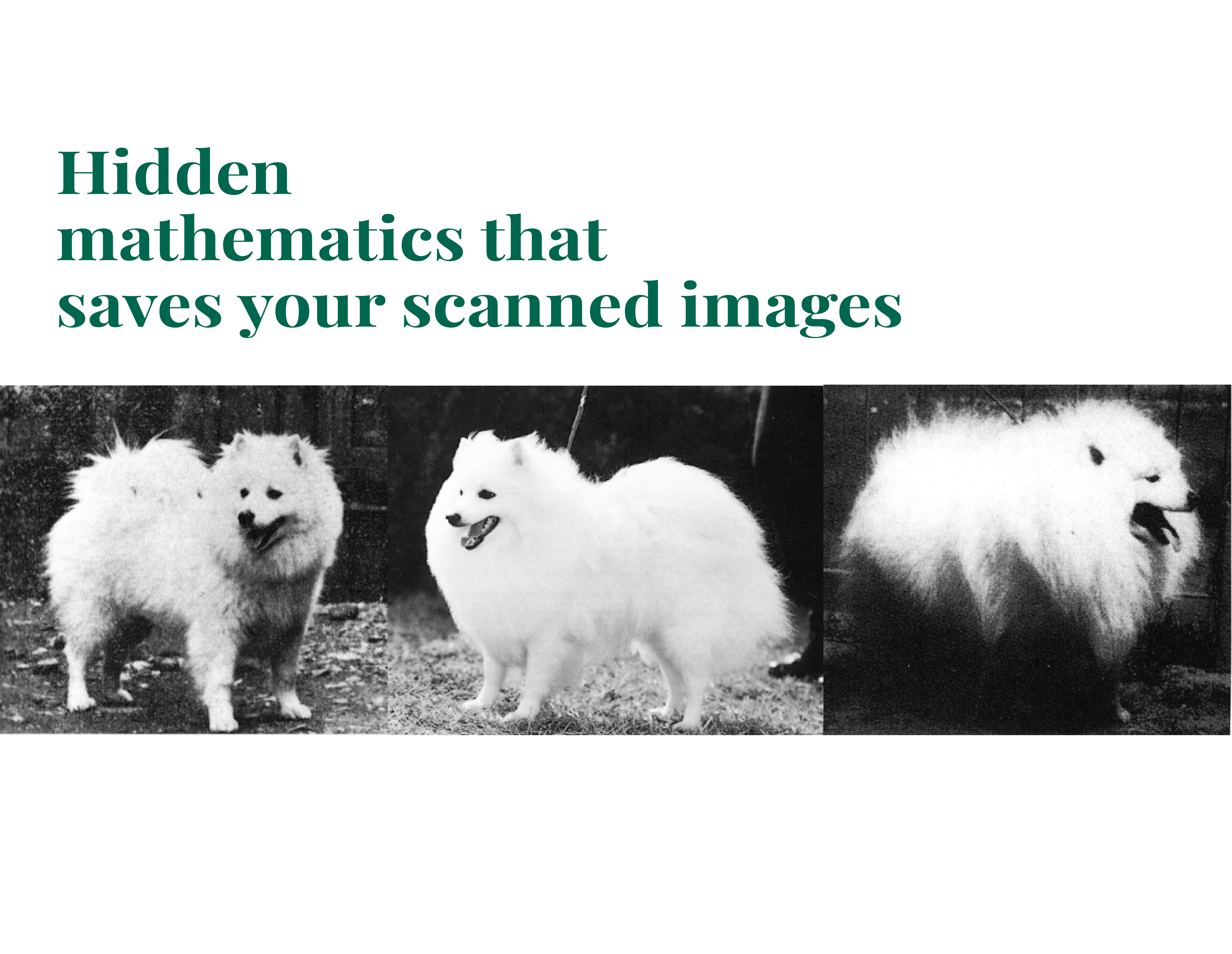
Scanned images often carry a hidden flaw – regular halftone dot patterns that degrade visual quality and destroy texture. These screen artifacts, typically introduced during printing or low-quality digitization, are not just cosmetic noise. They interfere with downstream processing, reduce clarity, and often break aesthetic continuity in otherwise valuable archival or editorial assets.
At Furnets, we faced this issue firsthand while working on the restoration of historical animal portraits. One particular case – an over-processed image of a Spitz – exhibited high-contrast halftone noise that no traditional denoising algorithm could effectively handle. The dots were not random noise; they were structured, embedded deep in the frequency domain.
We needed to remove them without damaging the texture, silhouette, or tonal gradients of the image. Existing solutions either failed outright or compromised too much in the process.
So, we built our own solution.
Why standard methods failed
Initially, we explored both classical and modern descreening techniques:
- Classical spatial filters (median, bilateral, wavelets) smoothed the dots partially, but they also smeared fine texture and outlines – especially problematic for fur restoration.
- Machine learning approaches, such as MopNet, showed promise on synthetic datasets but failed in real-world use. MopNet’s learned patterns couldn’t generalize to mixed-frequency dot noise. It frequently oversmoothed, blurred essential details, and lacked controllability.
- Naïve fast Fourier transform-based (FFT) approaches offered insight into where the noise lived in frequency space, but available implementations lacked control and were too destructive.
The problem was clear: we needed a frequency-domain method with spatial awareness and configurable precision.
Design goals
Our goal was not just to suppress dots, but to build a precision descreening tool with the following qualities:
- Operates in the frequency domain, where halftone artifacts are localized.
- Preserves mid-frequency details, especially important in natural textures like fur.
- Offers controllable parameters for thresholding, masking, and blending.
- Leaves the rest of the image untouched – no softening, no artificiality.
- Fast and scriptable, suitable for batch restoration pipelines.
Our method: FFT-based descreening with adaptive masking
We developed a custom FFT-based filtering approach with three major innovations beyond the standard FFT filtering:
1. Energy-normalized spectrum enhancement
Instead of analyzing raw FFT magnitudes, we applied a distance-based energy normalization to emphasize mid-frequency patterns, where halftone dots typically cluster. This helped suppress false positives in the low and high bands.
💡 The normalization scheme scales spectrum intensity based on the square root of distance from the spectrum center. This gives preference to the region where halftone interference usually appears.
2. Middle preservation via adaptive ellipse mask
To preserve core image structure, we introduced a configurable elliptical mask centered in the frequency domain. This “middle preservation” zone protects essential features such as edges, silhouettes, and tonal contours, which often sit close to the DC component.
💡 The radius and shape of the ellipse are dynamically computed based on the image size and user-configurable ratio. This ensures high-precision targeting without accidental damage to image structure.
3. Soft thresholding with Gaussian dilation
After isolating high-magnitude noise bands, we applied thresholding followed by soft Gaussian dilation. This prevents ringing artifacts and ensures smooth frequency suppression. The result is a smooth attenuation rather than abrupt cutoff – essential for preserving the natural look of the image.
💡 Gaussian smoothing is scaled relative to the mask radius, allowing broader transitions on aggressive settings and finer preservation on conservative runs.
The pipeline
The descreening process can be summarized as follows:
- FFT Transform (per channel): Convert RGB image channels into the frequency domain.
- Apply energy normalization: Emphasize mid-frequency features.
- Compute magnitude spectrum and threshold: Identify halftone peaks.
- Apply elliptical protection mask: Preserve central structure.
- Dilate thresholded areas: Expand suppression zones with Gaussian smoothing.
- Multiply the FFT by soft mask: Suppress only targeted frequencies.
- Inverse FFT: Reconstruct cleaned image with artifacts removed.

Before

After

Before

After

Before

After
In these examples:
- The halftone pattern was eliminated, even in shadow regions.
- Fur texture and silhouette remain fully intact.
- No artificial blurring, no loss of structural clarity.
- A historically valuable portrait, now free of printing noise.
Advantages over existing tools
| Feature | MopNet | Traditional FFT | Ours |
| Learns from data | ✅ | ❌ | ❌ |
| Works on real scanned artifacts | ❌ | ⚠️ | ✅ |
| Preserves mid-frequency details | ❌ | ❌ | ✅ |
| Adjustable parameters | ⚠️ | ⚠️ | ✅ |
| No dataset required | ❌ | ✅ | ✅ |
| Runs fast on CPU | ⚠️ | ✅ | ✅ |
Adaptability and use cases
Our FFT-based descreening filter is modular and easily integrable:
- Works on grayscale or RGB images.
- Suitable for scanned photographs, print archives, scientific imagery, and book illustrations.
- CLI interface for batch processing pipelines.
- Fine-tuned thresholds for varying print quality levels.
This tool was born from necessity – but its applications are broad. Any archive, restoration lab, or media production house working with scanned materials can benefit from it.
Conclusion
The core challenge in descreening is finding the balance – removing repeating artifacts while preserving the soul of the image. We found that balance by leveraging the precision of the frequency domain and adding control layers tailored to real-world conditions.
Our approach is neither blind AI guesswork nor destructive brute-force filtering. It is targeted, explainable, and tunable.
If you’re working with legacy images affected by halftone noise and need a solution that restores quality without compromise, the Furnets team is ready to help.
Leave a Reply